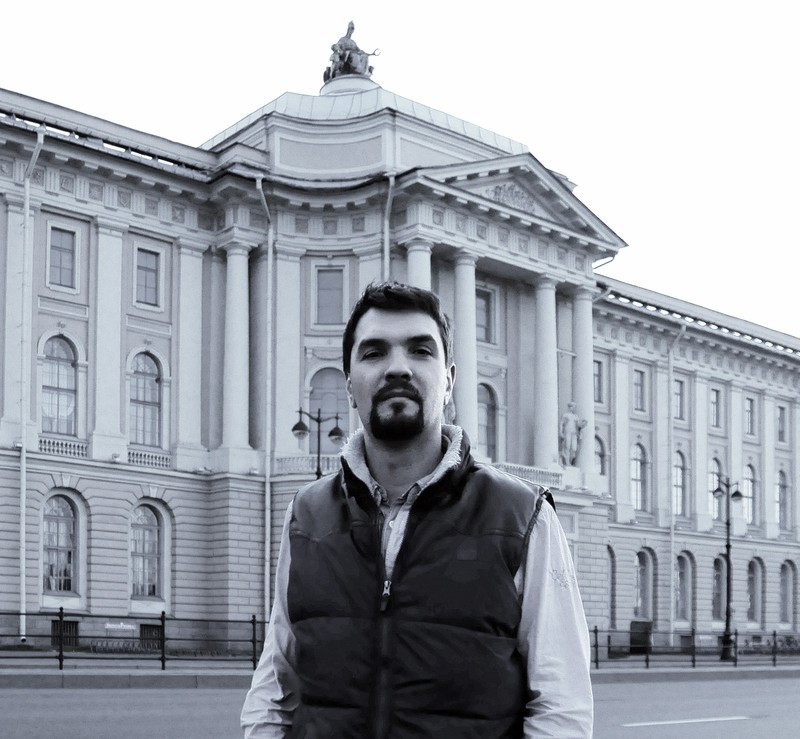


Biography
Born 30.08.1981 in St. Petersburg; printmaker working mainly in lithography for almost 20 years.
Education
St. Petersburg State Academic Institute of Painting, Sculpture and Architecture named after I. E. Repin of the Russian Academy of Arts, Department of Graphics 1999-2005 (post-graduate studies there in 2006-2008).
Career
Teacher of the Drawing Department of the St. Petersburg State Art and Industrial Academy named after A. L. Stieglitz 2009-2011. Also worked an assistant in the scientific research Museum of the Russian Academy of Arts Saint Petersburg. Almost 20 years Oleg works in printmaking, mostly in lithography.
At the invitation of the China printmaking Museum Mikhailov lithographs represent Russia at series exhibitions in China, project which unites more than 35 countries. "One Belt one Road" initiatives International printmaking exchanging project was arranged by Chinese Academy of Arts 2017-2019.
Master class and lecture in Zayed University Abu Dhabi, United Arab Emirates 2018.
Selected Exhibitions and Awards
- 2013First diploma at the all-Russia competition "the Image of the book". Moscow Russia
- 2015"LithograFica" solo exhibition at Small Hall of the Central Exhibition Hall "Manege", printing studio "Graphic Cabinet", St. Petersburg Russia
- 2017solo exhibition "Under water- above the water" as a part of the third international graphics Triennale "BIN 2017". St. Petersburg Russia
- 2018III International Festival "Days of Lithography" participant, Kunstlerhaus Munich, Munich.
- 2018Macao International Printmaking Bienniale participant. Macao
- 2018second prize-winner of the ex-libris competition "Marco Polo Journey on the Silk Road", Bodio-Lomnago Library, Italy.
- 2019The 7th Guanlan International Print Bienniale participant. China Printmaking Museum, Shenzhen China
- 2019solo exhibition at the Dalian Wenbo Art Museum, Dalian, China.
- 2019solo exhibition at Tacit Art Galleries, Melbourne, Australia.
- 2020lithography in the short list of the International competition of Senefelder, Haus der Stadtgeschichte, Offenbach am main.
- 2020Grand Prix of the Xinchow Hundred Cow Memorial Exlibris Design Contest, Hong Kong
About
The Russian artist and printmaker Oleg Mikhailov is obsessed by the sea. It is a passion with a long and personal history. As a child growing up in St Petersburg in the 1980s he remembers reading books about the ocean and dreaming of life amid its strange creatures and intrepid explorers. The French diver Jacques Cousteau [1910-1997] and Norwegian explorer Thor Heyerdahl [1914-2002] were childhood heroes whose adventures brought a sense of the exotic to the final years of the Soviet Union.
Mikhailov clearly remembers his primary school art class being asked to draw a portrait of what they wanted to be when they grew up. Other students drew 'cosmonauts, soldiers, engineers, architects'. Mikhailov drew himself as a diver on a coral reef. Looking back it is clear both parts of this classroom exercise came true. Mikhailov is an artist, someone who draws and paints for a living, and the sea is his abiding subject and the 'source of [all his] dreams and inspiration'. Childhood summers were spent at nearby lakes or by the sea. Fishing, swimming, and boating were his daily activities. Much later Mikhailov wrote that 'people in metropolitan life... dream of fleeing from high-rise buildings. Some people know how to climb mountains, and some people are summoned by drifting. I am a water man. I take a fishing rod or mask and flippers and strive to find depth in a mysterious world'.
Mikhailov undertook his studies in painting and printmaking in the Graphic Department of Saint Petersburg Academy of Arts. This institution began in 1757 as the Imperial Academy of Arts and moved to its current location in 1789. In Soviet times the college was renamed the Ilya Repin Leningrad Institute for Painting, Sculpture and Architecture after Repin [1844-1930], a preeminent 19th Century Russian realist painter. Today the college remains one of Russia's most important academic art institutions. It continues to teach classical modes of painting and drawing. Students spend long hours in front of life models and plaster casts, learning through practice and repetition to skilfully translate the three dimensional world into charcoal and paint.
Mikhailov regards this training as vital. In conversation he says there is now tension between the older professors and younger staff. The older professors want to preserve the historical pedagogy with its emphasis on practice and skill. The younger ones look to the anything goes state of contemporary art to embrace change and modernity. Mikhailov's stance is simple. 'As a student you should learn everything. Learn the old ways, learn to draw, learn to see and record the world. After you graduate you can change, throw away, find your own path. But first learn!'
This grounding is ever present in Mikhailov's work. There is a formal strength to the drawing, an ability to move seamlessly between depth and flatness that can only be developed through long hours in the studio and a close and particular observation of light and the natural world.
The movement between depth and flatness can be seen in Red Fisherman [2017], a combination of stone and offset plate lithography in four colours. In this picture traditional Chinese fisherman occupy pictorial space in a bold diagonal composition that echoes Japanese ukiyo-e prints such as Hiroshige's Pleasure Boats at Ryogoku Bridge in the Eastern Capital, a Triptych [1832-34]. Below the fisherman is an ocean composed not of waves or water but flat, graphically stylised images of the creatures of the sea. These animals and plants owe much to traditional wood engraving, and so speak to the long history of print, as well as the tessellations and pattern making of the 20th Century Dutch graphic artist MC Escher.
Similarly in Sunset Dragons [five colour plate lithograph and silkscreen, 2017] there is play between the flatness of the lithographic mark making and the perspectival depth offered by the architecture, plants, and fish. One fish, an Arowana or Golden Fish, a Chinese symbol of fortune and good luck, is presented in profile. The other moves forward into real space as it turns and swims out of the picture plane through a maze of lotus stems.
Both these prints and Qingdao Seafood Market [five colour stone and offset lithography with silkscreen, 2017] grew out of Mikhaolov's first visit to China in 2014 when he taught at St Peter's Gallery, a private art academy. Qingdao is on the coast between Beijing and Shanghai, and an important regional centre. Despite becoming the world's 8th busiest container port in 2017 Mikhailov observed fishermen in a state he felt was 'unchanged for more than 100 years'. 'The seafood market was near to my apartment and the academy. I would often think about the differences between the men who went to sea and their wives and daughters who worked daily buying and selling close to home.'
For Mikhailov the love of lithography came in his fourth year at college. He initially specialised in etching but eventually grew frustrated with the difficulties intaglio presents in working with colour, and at more than modest size. Lithography is different. Mikhailov says that lithography is closest to painting and drawing. 'It is very direct, whereas etching is a translation. What you see is what you get.'
He writes that 'Stone is a brutal object but at the same time very sensitive. It perceives the imprint of a finger and even breathing, requires special attention to itself and provides ample opportunities for creativity in response. The polished stone allows you to make a velvety light pencil drawing while at the same time [tusche] can be used like watercolour and scratched. Stone gives the opportunity to improvise and change some elements in the course of work, if you know the process. It is impossible to change the drawing completely, but it seems to me more than in other techniques, for example engraving, which does not forgive mistakes.'
Mikhailov feels lithography offers the widest opportunities for mark making. 'You can draw, paint and scratch all at once. It is not graphic like woodcut, not negative like etching. Everything is combined and available to you immediately.' Best of all is the sense of the past. He writes that 'Every stone has a history. Many of them are used for 100 years or more, several generations of artists have worked on these stones. I believe they receive the energy of many artists, even back to ancient times.'
It is in these ancient times we find a deeper connection between lithography and the sea. The delicate limestones favoured by lithographers are made of calcium carbonate, a mineral first found in the shells and skeletons of molluscs and corals. The slow accumulation of their bodies on the sea floor, followed by heat and compression in the Earth's crust, transform them into stone.
It is fitting Mikhailov uses a medium composed of ancient sea creatures to create an aquatic world full of movement and life. With skill and passion he transforms ink and stone, combining imagination and observation, surface and depth, the sure hand of a master draughtsman, and the marks and histories of lithography itself.
Damon Kowarsky artist (Australia 2019)
As a print master I have a rare opportunity to observe the artist in his, may I say, natural habitat, being a witness of the process of delivering a new piece of art, feeling what it costs.
I know Oleg Mikhailov for quite a time and I can surely say: the man is the master. And the mastery is shown not only in skills of drawing and painting. Oleg has that rare mixture of proficiency, imagination and observation seasoned with experience and passion.
I often wondered what pushes the artist to create, what lies behind the works. It is obvious that he has two main passions in life, one of which is the sea.
Indeed Oleg spends his vacations on the bodies of water. No matter what it is, a lake near the village, a bank of a river or the ocean shore, you'll find him fishing, swimming or diving, exploring the underwater world.
Once he said: "I've got a feeling that city men actually dream of escaping from the jungle of high-rise buildings they live in. That's why some engaged in rock climbing, others make it rafting on mountain rivers. I'm a man of water; I take a harpoon, mask and flippers and rush into the mysterious world of the deep sea."
Being a student of the St. Petersburg State Academic Institute of painting, sculpture and architecture named after I.E.Repin - the oldest and largest art educational institution in Russia, Oleg tried various printing techniques, and finally found his another love, his second passion - stone lithography, preferring it to the etching.
Which is not surprising at all. The frames of etching are too narrow for the artist, it does not allow him to reveal the whole potential and embody the idea in full.
Stone lithography is unique, it not only accommodates various printing techniques, but combines both printing and drawing. Moreover it allows to work with color and finally obtain the imprints of much bigger size.
But it is not that easy. At the same time stone lithography is the most difficult of all. To dig it, one must have patience and dedication since lithographic limestone is heavy and bulky, but yet quite sensitive; it accepts fingerprints, does not forgive mistakes and requires a special care.
Another part of stone lithography is the collaboration of the two - the artist and the print master. Being the latter, I admire Oleg's ability to use every opportunity that stone gives and constantly open new ones. His affection to improvise and experimentalize constantly rises skills.
Oleg's works won't leave you indifferent, bright and colorful, allegorical and a little bit surreal at times they are riddled with dynamism and expression. They show the viewer himself as if in some kind of a fairy mirror evoking bright and cheerful memories and emotions, they are about life and lust for life.
Alexey Baranov print master (Russia 2021)